I thought I'd share my process for any of you that are interested. (BUYER BEWARE: This story did NOT make the cut.)
The post Writing a Postcard appeared first on Rich Hailey Writer.
]]>Most of y’all know that I submit regularly to the “Postcards” series from Raconteur Press. For those aren’t aware, it’s an open submission call that happens from time to time whenever the gang go to a convention. They send an AI generated image to anybody who asks, and you must write a story of precisely 50 words, no more, no less, inspired by the image. You only have until the Monday after the con to submit the story, so there’s a time pressure added to the word count. It’s a fun challenge, and I’ve made the cut for two of the four volumes.
I thought I’d share my process for any of you that are interested. (BUYER BEWARE: This story did NOT make the cut.)
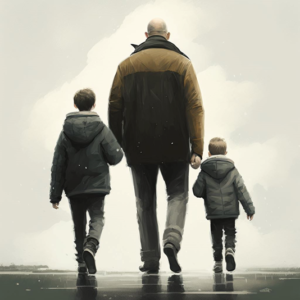
This is the image I received for the first postcards anthology.
My first step is to look at the picture and write down 10-20 words and phrases that quickly come to mind. I spend no more than a minute or two on this. For this image, I came up with:
- desolate
- wet pavement
- father and sons
- bleak
- walking away
- where’s Mom?
- cloudy gray sky
- jackets and parkas
- standing straight and shoulders back
- moving on
Next, I blow up the image, and look for fine details. Little things jump out and become hooks for the story, fleshing out the characters, or providing bits of the plot.
- The father is wearing a mask. There’s some kind of plague. Or the atmosphere is not healthy.
- Their posture is not slumped and defeated. They are walking away, but they are also walking forward. They’ve taken a hit, but they aren’t defeated.
- The older son is holding onto his father’s hand, looking for guidance.
- The younger son is less aware of what’s happened. He still believes that Daddy can fix anything and their current troubles will pass.
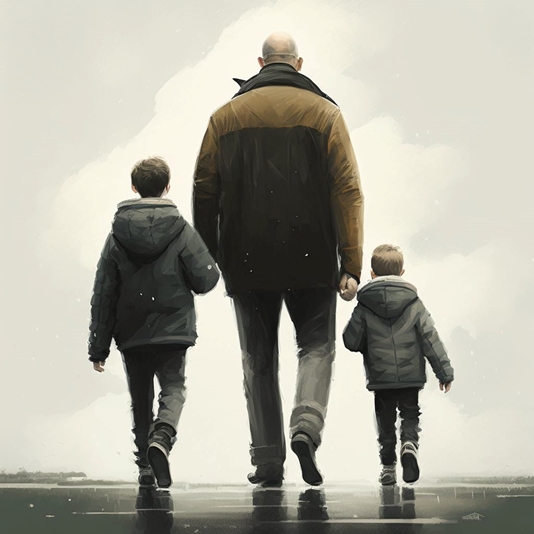
Then I sit down and write it out, ignoring word count. I tell the story conventionally capturing every nuance and detail.
Only then do I count the words. It isn’t pretty. In this case:
We leave the hospital, my boys and me. We’re all that’s left of our family.
We came to this damned place to build a new life, to escape the mess we’ve made of Earth, but that never works. We bring our problems with us.
Carol’s dead.
The Pain is what we call it. Neuropathic necrosis is what the docs call it. Untreatable. Incurable, and excruciating. It kills nearly everyone who contracts it, and that’s a blessing. The survivors don’t have much to look forward to.
Cathy’s suffering is over, but ours, well, it’s just beginning.
The evening rain is falling as programmed by the Colonial Terraforming Agency as the boys and I walk home.
Robert Jr puts his hand in mine while Billy skips along.
I’m gutted. No hope, no plan, no wife.
But I can’t let that show. God help me, but they need me and I have to be there for them.
“What do we do, Dad?” RJ asked quietly, holding in his tears for Billy’s sake.
“Just keep walking, son. That’s all we can do.”
Boys become men too soon in this world.
Next, I put it away for a while, at least an hour or so, maybe even overnight. When I pick it back up, I summarize the story. This let’s me isolate what the story is really about, which lets me condense it to the bare bones, eliminating extraneous bits and keeping only the most important parts, whether it is character beats or plot points or descriptions.
In this case:
A man walks home with his two sons after his wife dies of an illness. He knows that despite his own pain, he must be strong for his boys. He passes that lesson along to his oldest son. It’s too soon, but that’s life.
Right away, I see I can delete most of the stuff about the illness. And I don’t need the colonial setting anymore; the story can apply anytime, anywhere. The meat of the story is told in 44 words. But they aren’t the right words. The story is told, not shown. It’s time to go back to the first draft and edit.
My next draft looked like this:
We leave the hospital, my boys and me. We’re all that’s left of our family.
Carol’s dead.
The Pain is what we call it. Cathy’s suffering is over, but ours, well, it’s just beginning.
Robert Jr puts his hand in mine while Billy skips along.
I’m gutted. No hope, no plan, no wife.
God help me, but they need me and I have to be there for them.
“What do we do now, Dad?” RJ asked quietly, holding in his tears for Billy’s sake.
“Just keep walking, son. That’s all we can do.”
Boys become men too soon in this world.
I’m still way over the word count, but it’s manageable now.
I look back at the image, and see how much of the story is conveyed by the image. Maybe I don’t need to repeat what’s already there. Which sentences provoke an emotional response and which are just filler? Can I rewrite sentences to get rid of chronological cues and let the structure and order of the sentences convey sequence? Can I get rid of dialog tags, or if I hae to keep them, can I make them multitask, providing emotional content as well as narrative?
Finally, I go through the words themselves and look for better, stronger word choices for each one. If I can find words with multiple layers, so much the better. I rely primarily on my own vocabulary, but I’ll crack open a thesaurus as needed to jump start my imagination if necessary. Strong verbs and descriptive nouns remove the need for adjectives or adverbs, and misusing (pardon, I mean creative use of) punctuation can also shave off a few words.
This is usually the longest part of the work, and the most fun for me. Trying out different words occassionally inspires me to rewrite an entire sentence or move it to another place in the story for better impact.
The last step is finalizing the title. I usually have a version of the title when I write the summary, but as I refine and move things around, different titles occur to me, but by this point, I want the title locked down. I’ll review the story and make sure that every word builds to the titles. It’s a way to cheat and get a few extra words into the story.
Here’s the final version:
Carry On
Carol’s dead.
It’s a blessing. She’s beyond the Pain now.
I’m gutted. No hope, no plan, no wife, and no mother for my boys.
I’m not enough, but I’m all they have.
“What do we do?” RJ asked.
Sometimes, a boy learns the truth too early.
“Just keep walking, son.”
The post Writing a Postcard appeared first on Rich Hailey Writer.
]]>The post Hello 2023! appeared first on Rich Hailey Writer.
]]>
I do believe in setting goals and making resolutions for the New Year. It gives me a focus for the year and a way to measure my progress.
There is a difference between a resolution and a goal that most people tend to miss. A goal is a concrete achievement. It’s very specific. One of the things we teach in our professional development courses is how to set a SMART goal.
- Specific
- Measurable
- Achievable
- Relevant
- Timed
For example, if I’m setting a weight loss goal, I would say something like “I will weigh less than 215lbs by June 14.” I set a specific target, one that is measurable on a scale, and that involves a reasonable amount of time to achieve, and that has a deadline.
I left out relevant, and that’s because ‘relevant’ relates to a resolution.
Resolutions are not as cut and dried. They’re messy, hard to measure, and tend to be broader. For example, “I resolve to live a healthier lifestyle in 2023.” You see how that is not a SMART goal? But it still has meaning.
My goals must be relevant to my resolutions.
So here are my resolutions along with some goals for 2023.
- Be kind.
- Go out of my way to greet people
- Help others whenever the opportunity presents itself
- Swallow my pride
- Forgive offenses
- Be healthy
- Weigh <215 by June 14
- End all heart meds by June 14
- Exercise 1 hour 3 times per week
- Be appreciative of the efforts of those around me
- Praise freely; criticize sparingly
- Expand my horizons
- Learn a song every week on the ukulele
- Record and post one each month
- Learn a new language
- Finish my arcade controller
- Grow as a writer
- Complete 52 short stories by Dec 31.
- Complete 4 novels to final edit by Dec 31.
- Publish collection of the best short stories by Oct 1.
- Submit to 12 open call anthologies by Dec 31
- Submit to WOTF every quarter I am eligible
- Submit to both Baen contests
- Record and publish 12 audio stories
- Love
The post Hello 2023! appeared first on Rich Hailey Writer.
]]>The post 2022 in Review appeared first on Rich Hailey Writer.
]]>
It’s been an interesting year.
Today is Dec 31, 2022 and for me, it’s a day to look backwards to see where I’m coming from and where I’ve been. I assess the things that worked, the things that didn’t, and use that to lay out my goals and resolutions for the coming year.
2022, was a year of beginnings for me. For the first time, I started treating writing seriously,as something more than “Oh, that’s something I’d like to try. Following some great advice I got at the tail end of 2021, I wrote and sold a story. Since then, I’ve tried a few more, but nothing else has sold.
And that’s okay; I’m still learning this author gig.
I stepped outside of my comfort zone, and did some things differently. Lissa and I went to several conventions this year, and instead of focusing on having fun, I began to emphasize learning more about the job and craft of writing fiction. That journey culminated in 20Books Vegas, where I met some amazing people and learned exactly how much I need to learn to make this a success.
I recorded an audio version of my story and sent it out to a fe volunteers who listened and gave me some very encouraging feedback. I’m incorporating their suggestions in the final edit, and will post it on Amazon soon.
For the coming year, I’m setting several ambitious goals for myself, and I’ll share those tomorrow.
There are plenty of regrets and lots of things I wish I’d done differently, but the only thing I can do about those is learn, and do better moving forward.
And that’s what tomorrow’s post will be about!
The post 2022 in Review appeared first on Rich Hailey Writer.
]]>The post Crow Moon by Cedar Sanderson appeared first on Rich Hailey Writer.
]]>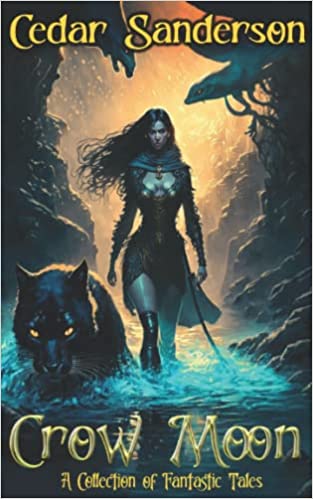 Crow Moon is a collection of eight short fantasy tales by writer, editor, artist, publisher, and lord knows what else Cedar Sanderson. Sanderson, who did the art for the cover, also produced artwork for each of the stories. something that set this book apart, and made it worthwhile to purchase a physical copy instead of just the ebook.
Each one of the stories carry with it a sense of wonder, sometimes sweet, sometimes sad, and sometimes awful, in both meanings of the word. The characters span a wide range, from simple people and quiet heroes to monster slaying avatars of dark gods, but they are each defined by their sense of duty, or obligation. The stories revolve around what they are willing to do, what sacrifices they are willing to make in order to fulfill that duty. In other hands, these stories could easily become heavy and overbearing, but Sanderson uses a lighter touch. Instead of bearing down on the weight her characters carry, she focuses instead on how they carry it, showing that courage is not always found in fighting a dragon; sometimes it’s in answering a simple question for a little boy.
Sanderson writes these stories almost like an artist’s sketch. Rather than go into great detail about the settings, the characters, and the backstory, she chooses instead to provide just enough detail to bring the reader into the story. Her deft touch leaves plenty of room for the reader to fill in scenes with their own imagination, and to integrate their own emotions into the story. Reading is always a collaborative process between the writer and the reader; Sanderson brings the reader more deeply into that collaboration, which magnifies the emotional impact of each story.
All eight stories are good reads, but for me, three stand out above the others.
First is Milkweed. I’ve never read anything that so well evokes what it means to be a woman, a wife, and a mother.
Second is A Breathe of Air. It’s short, but Sanderson packs so many emotions into each sentence. The impact builds slowly then hits you right between the eyes. It’s a gorgeous story.
Finally, The Domovoi’s Blessing. Styled as a Russian fairy tale, this charming story is a sweet reminder that trust and perserverence can go a long way towards finding a happy ending.
Those are my favorites, but you may like other stories better, and that’s one of the best things bout this collection. There truly are stories here for everbody, no matter your taste.
Highly recommended!
The post Crow Moon by Cedar Sanderson appeared first on Rich Hailey Writer.
]]>The post Weekly Update appeared first on Rich Hailey Writer.
]]>First of all, do you like the new digs? If you’re reading this via the link on Facebook, awesome! Welcome to my website. I plan on moving more and more of my posts over here. I’ll post links on Facebook back to here, but I prefer doing mjost of my longer posts fropm here.
There’s a couple of reasons for that. First, this is going to be my home on the web. Facebook is fine for short posts, sharing memes, and interacting with folks, but my posts tend to run longer than Facebook readers typically like. Most Facebookers are looking for 20-30 second interactions that they can like and then scroll along. When I write one of these updates, or post a review, I like to take a bit of time and space, and that simply works better here.
Second, I have a much greater degree f control over how my posts look. I can add inline images, host a video, link to a book or somebody else’s page, and all without worrying about Facebook throttling the post because I’ve triggered one of the algorythmically generated and unidentifiable landmines.
Which brings up the third reason, Facebook tends to be somewhat arbitrary in applying their standards and I’m putting too muich effort into these posts to allow them to just disappear becaue a bot doesn’t like a particular word choice I make.
Of course, as I post more here, I’ll be tweaking things to make them work better, and look better. I’ll be doing some other things, like building a mailing list, creating a newsletter, and stuff like that along the way, so keep your eyes opened!
Now, to the update!
- Weight – I weighed in at 265 this week for a loss of 3 more pounds. That’s a total of nine pounds lost. We leave for vacation in under 6 weeks and I’ve got a ways to go yet. Onward!
- Non Fiction – Everything is still on track. I’m hitting my goals and making my deadlines and interacting on social media. Growth is very slow, but it will come with time and persistance!
- Fiction – Horrible week. Truly horrible. And it’s all my fault, of course. I just had to write a post on maintaining a routine. Yep, things happened and my routine took a huge hit. Monday, I had family things to deal with, Tuesday and Thursday I lost to illness, Wednesday, I guess I’ll blame on illness as well. Friday, I got some writing done, but my word count really suffered for the week. But a once established, a routine has it’s own momentum and the only way to really lose that is to sit back and let it happen. So I wrote on the weekend and made up for some lost time, and I’ll be right back at it tonight at 9pm.
- Ukulele – I’m working on Hallelujah still. Such a powerful song about love and loss! I’m trying to meld a strumming pattern with fingerpicking, and singing at the same time. If I can nail this, it should be awesome!
- What I’m Reading – I finished Cedar Sanderson’s short story collection, “Crow Moon” this week and it is amazing! My full review will post tomorrow, and I’ve submitted an Amazon review as well. The short version is simple. Buy It! Each story is like an artist’s sketch; there’s enough detail to protray the story and to evoke an emotional response, but it invites you to supply details from your own imagination and emotions from your own experiences until it almost feels like you are collaborating with the writer in crafting the story. I’ve started “The Debare Snake Launcher” by Joelle Presby. Presby spins a tale of old and new cultures coming into conflict as the world’s first space elevator is being built in Africa.
- I mentioned before that I was working on an audio version of my short story. I finished the raw recording and did a basic edit last weekend and it has gone out to my alpha listeners. Based on their feedback, I will either continue to pursue recording my own stories, (and maybe do some recordings for other writers) or retire from voice work, never to be heard from again. (No pressure, alphas. Just my career. That’s all!)
And that’s it for this update! Remember, tomorrow is a full review of Crow Moon, then Wednesday will be my weekly craft post, then Friday, writer’s choice. WHo knows?
Have a great week!
The post Weekly Update appeared first on Rich Hailey Writer.
]]>The post David Carrico: The Blood is the Life appeared first on Rich Hailey Writer.
]]>First of all, if you’re Orthodox, like Chaim Caan, you have an immediate problem. Consuming blood is forbidden. He reaches out to a Rabbi who connects him to an organization that can help him.
And use his new abilities.
What struck me most about this story is that being a vampire is not glamorized in any way. No angsty, sparkly pedophiles here. These vampires are fierce, strong predators. Fortunately for Chaim, he finds his way to an organization that helps him harness the predator he’s become, channeling his aggression into the defense of others.
But it’s not easy. The list of deficits severely circumscribes his life and his relationships. There’s certainly no glamor in dealing with blood breath. He’s also limited in his ability to form relationships. He can’t eat, or go out drinking with classmates, nor can he have a girlfriend. And since he has an indefinite lifespan, anybody he manages to form a bond with will grow old and die, while he remains the same.
It’s a bleak prospect, and Chaim must find a reason to live and to fight off the anger that comes with his transformation.
He’s helped by Mordechai, an older vampire who mentors him, as well as a Jewish organization which acts to defend Jews from persecution throughout the world.
I got the feeling that Carrico has more to say in this world, as there are several questions raised, not least of which is discovering who selected Chaim to be turned and why. Turning rarely happens accidentally; it takes effort.
I don’t know whether Carrico is Jewish or not, but he clearly did his homework as Judaeism permeates every facet of the book. Chaim is devout and observant, and this is well communicated to the reader, so much so that I found myself placing my own Christian faith into a new context. I gained a deeper appreciation for the Jewish faith and those men and women who walk in it. It makes me want to learn more about their faith and their culture.
That’s not what I expected from reading a vampire novel, but it was a welcome surprise!
The post David Carrico: The Blood is the Life appeared first on Rich Hailey Writer.
]]>On the other hand, I can write on the forces behind our political division and give my opinion on causes and potential solutions. This might still be too much for some folks, and that's okay. My right to speak freely in no way obligates anybody else to listen.
The post My 2 Cents appeared first on Rich Hailey Writer.
]]>
Announcing a New Feature
 I’m adding a new feature to the blog. It’s a new category called “My 2 Cents.”
I’ve been an opinion blogger off and on since 2002. I started on Blogspot, then migrated to a shared host and Expression Engine, then to WordPress. The rise of social media put a huge crimp in my style of blogging as most people became enamored with 140-character tweets, and I posted long form essays.
I adapted and learned to condense my thoughts and posted mostly on Facebook.
Then social media went south. I’m not going to get into that whole mess; there are strong feelings on both sides and no matter what I say, nobody will change their minds on it now. So, I pretty much abandoned social media and blogging.
But things are changing. There is a possibility that a free exchange of ideas may be coming back to social media, which would be an awesome thing. That, plus my efforts to market my writing, means I have engaged with social media once again. But with a few caveats.
I’m not getting political. Again, there’s little to no chance that something I write will cause somebody else to change their mind. At most, I’ll just piss them off, and who needs that?
On the other hand, I can write on the forces behind our political division and give my opinion on causes and potential solutions. This might still be too much for some folks, and that’s okay. My right to speak freely in no way obligates anybody else to listen. If you don’t want to read these posts, then skip over them and focus on the writing related ones.
You won’t hurt my feelings a bit.
The post My 2 Cents appeared first on Rich Hailey Writer.
]]>The post Tangled in Time: Non-Linear Storytelling appeared first on Rich Hailey Writer.
]]>Tangled in Time: Non-Linear Storytelling
 Why I Hate it and Why I’m Using it for This Short Story
First of all, let’s get this out of the way: I have no degrees in English, Creative Writing, or any credentials of any kind as far as Literature goes. What I do have is 5 decades as a consumer of fiction; written, spoken, visual, and other. I am a voracious reader, usually reading 3-4 books at a time, unless I’m reading nonfiction, in which case I tend to concentrate more and read slower.
So, having read thousands of books, and watched hundreds of TV show episodes, I’m very familiar with non-linear storytelling, it’s use, and too frequently, it’s abuse.
 What is Non-Linear Storytelling?
Picture your favorite long running TV show. Inevitably, there’s an episode or two (or six or 12, depending on how lazy the writers are) where the show’s pre-credit stinger starts off with the protagonists in a very bad or unlikely situation. The scene unfolds to a point of high tension (Will these best friends actually shoot at each other?) before the Intro rolls and we go to commercial. After the commercial, we get a text crawl at the bottom of the screen saying “36 hours ago” or some such, indicating we’re going to step back in time and discover just how our heroes found themselves in such a precarious situation.
It’s a technique, a bit of artifice to try and build tension because the writers couldn’t do the work of maintaining your interest without some threat. To be fair to the TV folks, they have to write multiple scripts in a short period of time, so sometimes shortcuts are unavoidable. There are also times when nonlinear storytelling can be extremely effective in visual media.
Take the show Arrow for example. Most TV episodes have an A story and a B story; the A is the lead, and the B is a side story that often either plays into the A story or addresses the episode theme from another point of view. And sometimes the B story is there to keep the supporting cast happy. In Arrow, the B story was almost always a flashback, or in the latter seasons, a flash forward. It performed two functions. It filled in the five-year gap between Oliver Queen’s disappearance and reappearance, and it almost always provided motivation for his actions in the A story.
It added depth to the storyline without feeling like a gimmick to grab your attention.
What’s Wrong with It?
In my opinion, it’s usually a sign that the writer can’t build an effective opening scene, so they cheat by starting with the climax.
As writers, we’re told that we must hook our audience as quickly as possible or we’ll lose them forever, and that’s not wrong. I know one author who is kind enough to review stories for new writers, and his standard is they get three paragraphs for a short story, or three pages for a novel to capture his attention. If they can’t do it by then, he stops.
That’s pretty harsh, but I know another editor/publisher who lowers that to three sentences.
Yikes!
So there’s tremendous pressure on a writer, particularly a new one who is striving to build an audience, to hook the reader early. In most cases that I’ve read, the writer uses the climax as a hook, but then is back to square one, trying to maintain the reader’s interest as he slogs through the set up. It doesn’t eliminate the need for tight writing at the beginning of the story; it just postpones it. And worse, now, after teasing the reader, then forcing him to wade through the set up, you absolutely must nail the pay-off. Anticipation is a wonderful thing, unless you leave your reader hanging with a bail-out ending.
Then you may lose them forever.
So Why am I Using it?
Because I’m cursed. Inevitably, when I say I don’t like to do something, within moments, I’m being forced to do it.
My protagonist is a Paladin with PTSD. He faced a horrendous battle, and now has been retired from combat duties to act as an administrator and adjudicator. So of course, he’s thrown into conflict and combat.
I started writing the story linearly, with his arrival in the village and the low-level conflict he was sent to resolve. I wove the information about his PTSD and its causes into the story, then started the big fight. But as I wrote, something felt off to me. The first battle, the one in the past, was so horrific, and played such a huge role in his actions in the present, that I dint feel comfortable having it happen off screen. I rewrote it, fleshing out the battle as more or less a prol0gue to the main action, but it was too big; it dominated the first half of the story, making the resolution feel anticlimactic.
So I went non-linear. I started with the present day fight, segued to the past, then returned to the present battle. This minimized the initiating event of the story, his presence in the town to adjudicate some small matter, but that was okay. That part of the plot wasn’t critical. What was critical was his response to the earlier battle, and how it colors his response to the current one.
Shorter version: I’m using the technique because the story told me to.
Let the Story Tell Itself
That’s what I’m doing. I’m a pantser; it’s what I do anyway. I let the story tell itself. It goes much more smoothly that way. Is it the right thing in this case? I honestly won’t know until I finish the story and get it to a couple of beta readers. All I can say with assurance right now is the story is flowing much better than it was when I tried to do it with a linear narrative.
The post Tangled in Time: Non-Linear Storytelling appeared first on Rich Hailey Writer.
]]>The post My LibertyCon Challenge! appeared first on Rich Hailey Writer.
]]>
Yeah, I know. It’s ambitious. Or insane. Take your pick. So let me tell you where this is coming from.
I Am the 95%
I just finished reading Titans Rising, as well as Have Keyboard, Will Type (both highly recommended by the way and TR is reviewed here.), and I joined the 20Booksto50k(r) Facebook group (Also highly recommended.) One piece of advice has been consistent in all three places: You have to finish your book before you can sell it.
It seems obvious, right? But it’s no less true for that. You must finish the book. And by finish, I mean get it out of your writer hands and into the reader’s hands, with everthing that goes along with that. Covers, formatting, book design, marketing and so on.
For me, I need a deadline in order to finish. A drop dead, no-shit, end of the world deadline. One of the things Bill Webb talks about in Have Keyboard is the army of people who “are going to write a novel” or “are writing a novel” that never quite manage to finish writing a novel. AS he says, 95% of the people who start to write a novel never finish. I think he’s optimistic in that assessment and I say that as somebody who fits that definition. I have two different novels “in progress” and a third percolating in my head. The first novel has roughly 25,000 words, the second about 12,000.
I’ve been working on them for years.
That’s bullshit. I’ve been playing with them for years. The LibertyCon Challenge is my way of escaping the 95% trap.
Leaving the 95%
When I was encouraged to submit a story for an anthology, there was a deadline, and that made it real. I worked on the story, wrote a couple of false starts, then found the voice and tore through the first draft in less than a week. I gave it to a couple of alpha readers who made some good suggestions. I revised accordingly, fixed typos, and submitted at the deadline.
It sold.
This did a couple of things for me. First, it made me squee out loud, scaring the cat. Second, it gave me a sense of affirmation. I can tell a good story. People will pay to read what I write. I CAN do this.
But I need a plan and a deadline.
Taking the Next Step
I have set a few goals.
- Submit a short story to the Baen Fantasy Contest
- Submit a short story to the New Mythology open call
- Submit a short story to Sanderley for the next Going Home anthology
- Have a novel published by CKP, either shared universe or stand alone. (Or both)
- Have a novel published by Baen.
You’ve probably noticed these are not monetary goals. These are what I’m going to call craft goals; they aren’t signs of a successful professional career because they don’t include the ultimate metric for professional success: money. But they are important to me nonetheless as measures of how well I am mastering the craft of writing. If editors and publishers I respect find my work worthy of taking on, that’s confirmation that I am continuing to learn and grow my ability as a writer and a storyteller. (Hmmm. The basis for another post. What’s the difference and why does it matter?)
Now, as important as that is, I also need to pay attention to the business side, and that means looking at revenue. Like I said at the beginning, a book is finished when it is getting into the hands of readers, and that leads to a different set of goals, the first of which is my LibertyCon challenge.
Minimally Viable Products
The mantra of 20Booksto50k(r) is write-publish, write-publish, lather, rinse, repeat. Quantity has a quality of its own. They refer to their books as ‘minimally viable products.” In short, a poorly edited book that’s on the market will sell more copies than a perfectly edited book that’s still in revision. I get what they are saying; a book can’t earn money until it’s published, and editing/revising takes a huge chunk of time, during which you aren’t making money. The model comes straight from Microsoft, which is famous for releases that are buggy as hell. Microsoft uses its customer base as beta testers, fixing bugs after deployment.
Everybody knows this; everybody gripes about how buggy Microsoft products are on launch. Yet everybody still uses them.
Of course, Microsoft has the advantage of operating in an area with a limited number of competitors; books aren’t like that. If I piss off a reader with a poorly formatted, poorly edited book, that reader has a million other options for their next book purchase.
I won’t put a book or story out that’s filled with typos, continuity errors, etc. On the other hand, they aren’t wrong. A tight deadline will force me to work fast and clean in order to have enough time to edit/revise the manuscript, find a good cover, write a blurb, design the book and so on.
The LibertyCon Challenge
LibertyCon is just 9 weeks away. Many 20booksto50k writers generally aim to put out a novel every 5 weeks or so. That’s not a viable option for me right now; I have too many other projects (none of them sold, mind you, but one with a fast-approaching deadline) plus real-life commitments. But 5 weeks to write, then 4 weeks to revise, format twice(ebook/print). then do everything else to have physical copies available for sale at LibertyCon..
This is going to be interesting!
The post My LibertyCon Challenge! appeared first on Rich Hailey Writer.
]]>The Folks who gave so generously of their time and resources to contribute to Titans Rising aren’t stopping there. They’re happy to share what they’ve learned to new writers (like me) and listed resources and contact information in their respective chapters. As promised, here is a list of those resources. While this list is extremely helpful, without the context you get from the book, you’ll miss out on a lot of the value. In other words, don’t skip the book for the Cliff Notes.
Writer and Publisher Resources of the Titans
(*=multiple recommendations; items in italics are contact information)
- Chris Kennedy Publishing
- Stanford Publishing Course
- Publishers Weekly
- Wordfire.com
- Wordfirepress.com
- Superstars Writing Seminars*
- 20Booksto50K*
- 20booksto50kconference*
- www.mountaindalepress
- Facebook: The Devine Dungeon
- Amazon Dakota Krout
- Chicago Manual of Style, or any Style guide really.
- the sneakykittycritic.com
- the Keystroke Medium podcast
- Aethon Books
- Tim C Taylor
- Lydia Sherrer
- lydia@lydiasherrer.com
- badashpublishing
- Conundrum Publishing
- The Bestseller Code
- Front Line Publishing Inc
All of the resources above come from the stories told by the Titans of Titans Rising, or are ways to learn from the Titans themselves.
It’s certainly a great place to get started learning how to do what they have already done.
The post Writer resources from Titans Rising appeared first on Rich Hailey Writer.
]]>