The post My LibertyCon Challenge! appeared first on Rich Hailey Writer.
]]>
Yeah, I know. It’s ambitious. Or insane. Take your pick. So let me tell you where this is coming from.
I Am the 95%
I just finished reading Titans Rising, as well as Have Keyboard, Will Type (both highly recommended by the way and TR is reviewed here.), and I joined the 20Booksto50k(r) Facebook group (Also highly recommended.) One piece of advice has been consistent in all three places: You have to finish your book before you can sell it.
It seems obvious, right? But it’s no less true for that. You must finish the book. And by finish, I mean get it out of your writer hands and into the reader’s hands, with everthing that goes along with that. Covers, formatting, book design, marketing and so on.
For me, I need a deadline in order to finish. A drop dead, no-shit, end of the world deadline. One of the things Bill Webb talks about in Have Keyboard is the army of people who “are going to write a novel” or “are writing a novel” that never quite manage to finish writing a novel. AS he says, 95% of the people who start to write a novel never finish. I think he’s optimistic in that assessment and I say that as somebody who fits that definition. I have two different novels “in progress” and a third percolating in my head. The first novel has roughly 25,000 words, the second about 12,000.
I’ve been working on them for years.
That’s bullshit. I’ve been playing with them for years. The LibertyCon Challenge is my way of escaping the 95% trap.
Leaving the 95%
When I was encouraged to submit a story for an anthology, there was a deadline, and that made it real. I worked on the story, wrote a couple of false starts, then found the voice and tore through the first draft in less than a week. I gave it to a couple of alpha readers who made some good suggestions. I revised accordingly, fixed typos, and submitted at the deadline.
It sold.
This did a couple of things for me. First, it made me squee out loud, scaring the cat. Second, it gave me a sense of affirmation. I can tell a good story. People will pay to read what I write. I CAN do this.
But I need a plan and a deadline.
Taking the Next Step
I have set a few goals.
- Submit a short story to the Baen Fantasy Contest
- Submit a short story to the New Mythology open call
- Submit a short story to Sanderley for the next Going Home anthology
- Have a novel published by CKP, either shared universe or stand alone. (Or both)
- Have a novel published by Baen.
You’ve probably noticed these are not monetary goals. These are what I’m going to call craft goals; they aren’t signs of a successful professional career because they don’t include the ultimate metric for professional success: money. But they are important to me nonetheless as measures of how well I am mastering the craft of writing. If editors and publishers I respect find my work worthy of taking on, that’s confirmation that I am continuing to learn and grow my ability as a writer and a storyteller. (Hmmm. The basis for another post. What’s the difference and why does it matter?)
Now, as important as that is, I also need to pay attention to the business side, and that means looking at revenue. Like I said at the beginning, a book is finished when it is getting into the hands of readers, and that leads to a different set of goals, the first of which is my LibertyCon challenge.
Minimally Viable Products
The mantra of 20Booksto50k(r) is write-publish, write-publish, lather, rinse, repeat. Quantity has a quality of its own. They refer to their books as ‘minimally viable products.” In short, a poorly edited book that’s on the market will sell more copies than a perfectly edited book that’s still in revision. I get what they are saying; a book can’t earn money until it’s published, and editing/revising takes a huge chunk of time, during which you aren’t making money. The model comes straight from Microsoft, which is famous for releases that are buggy as hell. Microsoft uses its customer base as beta testers, fixing bugs after deployment.
Everybody knows this; everybody gripes about how buggy Microsoft products are on launch. Yet everybody still uses them.
Of course, Microsoft has the advantage of operating in an area with a limited number of competitors; books aren’t like that. If I piss off a reader with a poorly formatted, poorly edited book, that reader has a million other options for their next book purchase.
I won’t put a book or story out that’s filled with typos, continuity errors, etc. On the other hand, they aren’t wrong. A tight deadline will force me to work fast and clean in order to have enough time to edit/revise the manuscript, find a good cover, write a blurb, design the book and so on.
The LibertyCon Challenge
LibertyCon is just 9 weeks away. Many 20booksto50k writers generally aim to put out a novel every 5 weeks or so. That’s not a viable option for me right now; I have too many other projects (none of them sold, mind you, but one with a fast-approaching deadline) plus real-life commitments. But 5 weeks to write, then 4 weeks to revise, format twice(ebook/print). then do everything else to have physical copies available for sale at LibertyCon..
This is going to be interesting!
The post My LibertyCon Challenge! appeared first on Rich Hailey Writer.
]]>Last week I read the book Titans Rising which gives writers and small press publishers guidance on how to succeed in today’s rapidly changing publishing environment. The book is largely made up with successful publishers and writers answering a series of questions about themselves and their success. Besides providing an interesting cross section of experiences, it also provided a long list of resources for writers like me, who are just starting their journeys. After I finished it, I posted a review which you can read here. Since I plan on becoming a Titan, I decided to answer the same questions they did.
And here we are.
Biography
This should be good practice for the “About the Author” blurb.
 I was introduced to science fiction at a young age, courtesy of the nun running the library where I attended Catholic grade school. The library had a complete selection of Heinlein juveniles, along with Clifford Simak, Arthur C Clarke, Isaac Asimov A.E. Van Vogt and many others. My guess is that this was one of the priest’s private collections that he donated since I don’t see a Catholic diocese buying science fiction in 1969. After devouring all the SF they had, multiple times, I branched out into other genres but SF and later fantasy remained my go-to reads.
I joined the Navy as a nuclear reactor operator after the University of Tennessee advised me to take a semester time off. I had developed the bad habit of attending class only on exam days. I passed the classes, but the teachers had a problem with my approach, and graded accordingly. I spent almost nine years in the Navy, acquiring a wife and 6 kids along the way. From there, I worked a variety of jobs until I got into developing and giving industrial training in 2004 or so, which turned into a technical writing gig, as well as some programming.
Along the way, I picked up a side gig as a sports stringer for the local paper on the strength of a blog I started in 2002. This was my first regularly paying gig as a writer and photographer, since I got paid a few extra bucks if I provided pictures. The money wasn’t much, but it paid for a nice camera, some lenses and a couple of laptops over the years. Each of these jobs involved writing to deadlines, communicating with multiple audience, and required both discipline and creativity. All of this will help as I work on becoming a Titan.
A divorce and new marriage upped the kid count to eight, and they have blessed me with 17 grandkids so far.
When I’m not writing, I enjoy gaming, hiking, swimming, reading, knitting, stargazing, woodworking and making awesome barbeque for my friends and family.
Education
I’m an autodidact polymath. I love learning new things, which is why I loved being a trainer. The military has a saying, that you never really know a subject until you try to teach it, and that is 100% true. I learn new things every time I teach a class, and that’s the way I like it. As for formal education, my semester break from UT has lasted almost 30 years now, but I still plan on finishing a degree.
Eventually.
On the other hand, if I want to learn something, I just fire up the computer and dig in. Did you know that MIT has a large portion of its curriculum available online for free? Lectures, notes, assignments, everything but the textbooks. I’m working through calculus right now so I can dive into physics for real. I have a hard spot with the whole concept of dark matter. It’s too much like a fudge factor for me, but until I have the math to understand the theory, I can’t prove my suspicions.
Being self-taught is excellent preparation for becoming a Titan. It’s not always about what you know; it’s about what you can learn. I’ve learned how to learn.
Influences
Instead of talking about who has influenced me as a writer (early Stephen King, Robert Heinlein, Ray Bradbury, Robert Jordan, Harlan Ellison, the list goes on) I’m going to talk about the guy who motivate me by showing that I can tell a story that people like.
High school freshman English, we were all assigned to write a tall tale. I wrote about an Irishman who fell into a bottomless hole and wound up on the other side of the earth. Once the assignments were turned in, the teacher read them for the class, keeping the author’s names secret. As each story was read, the class reacted. One guy, Alex, became the ultimate arbiter of each story. If the story failed, in a laconic voice, he would say, “I’m still thirsty.”
When my story came up, I tried to keep a poker face, waiting for Alex’s remarks. “My thirst,” he said, “is quenched.”
That was the point that I knew I could tell a story that people would respond to. And that formed my primary goal. When I finish a story, I want to hear Alex’s voice saying “My thirst is quenched.”
Path to Publication
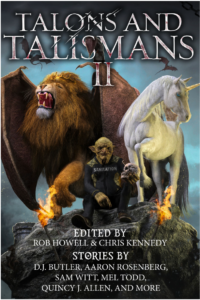 I have one story out, but “a journey of a thousand miles” and all that. My first step was sitting down and talking with Rob Howell, who publishes the New Mythology line of books for Chris Kennedy Publishing. I’d met Rob before at LibertyCon, a literary SFF con in Tennessee, and we’d enjoyed talking about his books and stories. Rob is a big-hearted guy who is all about helping new writers get their start, so when I saw him in 2021 at another con, I decided to ask his advice on getting a book published.
He said four things.
- Start with short stories in anthologies. You can write them faster, you get the advantage of being in a book with established authors, and you show you can write to a deadline and be professional.
- Develop relationships with publishers in your field. This doesn’t mean shmooze them. It means learning what they want to publish, what they are looking for, and demonstrating that you can deliver it. Of course, a little shmoozing doesn’t hurt.
- Develop a social media presence. Even before you have fans, give them a way to find and follow you. Publishers are looking to leverage any marketing edge they can. If you’ve already built the platform, you’re ahead of the game. At the same time, you have to work the platform. In Titans Rising, there’s a story of a publisher rejecting a book, not because it was bad, but because the author didn’t show that he was willing to do the hard work of marketing the book. Small press publishers have limited resources. Don’t make them work harder than you do in promoting your work.
- Once you’ve demonstrated to the publisher that people will pay money for your work, and you’ve developed a decent sized and active fan base, then put the effort into writing longer works.
Then he told me he had an open call for submissions. I read the details, read a few books that he had published, then wrote and submitted my first story ever.
It became my first sale and my first step towards becoming a Titan
The Hard Lessons I’ve Learned
I suck at running a business. I’ve proven that to myself by failing, and I hate failing. I have no interest in running a business. Accounting, invoicing, taxes, etc, they all bore me to tears. Unfortunately, in the world of independent and small press publishing, a writer who doesn’t practice sound business management will quickly fail no matter how good their story is.
So how am I solving this?
I have friends and family members who love the business side of things and I’m enlisting them to shore up my weak areas. I can’t totally divorce myself from the business side of the house, but I can reach out and get help from people who are better at it than I am.
Come to think of it, that advice applies more generally as well. If you find a weak spot, shore it up yourself as best as possible, and get help from people who are better than you.
Where am I Now?
I’m at the very beginning. I have one sale, and I’ve got requests for more stories from a couple of publishers, and I’m constantly looking for more open calls for submissions. I’m still working on a couple of novels, but they are on the back burner while I get stories out in circulation. I have a fast-approaching deadline for the Baen Fantasy contest and I need to finish and edit a story for that. I’m building my marketing platform (Hello marketing platform!) and planning con travel, not just for fun but to continue networking with Titans and other up and coming writers/publishers.
Where do I See Things Going?
This question has two answers.
For me, I expect to place a few more short stories in open call submissions. The next step will be when I’m asked to contribute directly, rather than through an open call. The next step is to finish and submit a novel and get it accepted. Whether it’s a traditional publisher or a small/Indy press depends on what is happening by then. As an alternate, if I can’t get any traction, but I still think the novel is good, I’ll self-publish. With the help of some good friends of course. As a look at the logo for this site shows, my graphic design skills are somewhat lacking.
And then, it’s off to the races. If I do it right, and that means writing, publishing, and marketing, then I’ll make enough money to do it all over again. And again. And again.
If I don’t do it right? Figure out what I did wrong and try again. And again. And again.
Persistence is the key.
Contact Info
rich@richhailey.com
www.richhailey.com
Facewbook and other social media to come.
The post Becoming a Titan appeared first on Rich Hailey Writer.
]]>And failing.
The post Titans Rising: Publishing in the 21st Century appeared first on Rich Hailey Writer.
]]>Edited by William Allen Webb and Chris Kennedy, Titans Rising is a manifesto combined with a how-to book on writing and publishing. I am not exaggerating when I say it may be the most important book on how to succeed in today’s everchanging climate. Independent presses are springing up everywhere. Amazon has crashed the gates of traditional publishing and the few major houses left standing are reeling, trying desperately to hold onto control of the market. And failing. It’s a real-life Game of Thrones and the Big 4 are playing the role of Ned Stark, clinging to the past even as their heads are on the chopping block. Want a different analogy? Okay. The Big 4 are the dinosaurs; Amazon is the comet that wipes them out, and the Independent Presses are the small squeaky mammals who improvise, adapt, and take over the world. (Hmmm. Small Squeaky Mammals. Could be the name of a publishing company. Or a bad punk band.) However you want to look at it, publishing is changing and the pace of the change is accelerating. Just last month, Brandon Sanderson turned the publishing world on its head when he announced a Kickstarter to publish the four novels he wrote during the travel restricted period of the shut downs. Titans Rising shows you what you need to do to build your audience in the most credible way possible: 19 highly successful writers and publishers, from small press, indy and traditional, share their stories on how they achieved success. Not only that, but they share the mistakes they made along the way, and the resources they found that helped them get passed those mistakes It is said that a mart man learns from his mistake. Well, I think a smarter man learns from somebody else’s mistakes, and the generosity of the Titans in this book makes it possible to do just that. In fact, the resources listed alone are worth the price of the book. There are a lot of scams out there; the Titans are helping new writers and publishers to avoid some of them. One of the things I plan on doing on my second read through is to compile a list of those resources. I’ll post that list here once I do. The book is a fast read, but one I’ll come back to time and again because there’s so much good information, and just as importantly, encouragement. The Titans talk about the hard parts as well as the good parts. Seeing your stories told and being shared is awesome, but the process to get to that point is hard work and plenty of it. There will be setbacks; there will be failure and rejection. But they’ve been there, and weathered it, showing you that you can as well. Like I said at the top, I just finished the book, and it got me so fired up that even though this site is nowhere near finished, I had to write this first post, just to get the ball rolling. The closing of the book takes the advice from the Titans and turns them into Action Steps. I’m taking action. One of the points of emphasis is the absolute importance of building a marketing network, including social media, blogs, writer groups, and so on. This site you are on right now is my start at doing just that. I’ll be adding a Facebook author page, developing my Amazon page, setting up a Twitter feed, and all the other parts that go along with it. If you’re reading this close to its publish date, then congratulations; you’re here from the beginning. Welcome aboard, and I hope you enjoy the trip. I plan on being a Titan. Notice I didn’t say I want to be a Titan. Wanting, aspiring, hoping, these are all passive expressions. There’s no action implied. I’m planning and executing the plan. That’s the first step.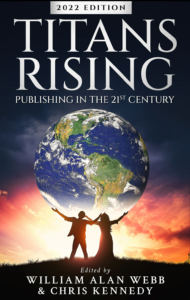 Not only is the paint not dry on this site, I haven’t even finished building the foundations and I’m already writing a review! That’s how important Titans Rising is.
Brandon Sanderson’s Kickstarter
 He raised $42 million dollars in a month. As is pointed out in Titans Rising, that’s 10x more than one of the biggest SF publishers brings in over an entire year. Sanderson has paid attention to the market, and has learned the lessons provided in Titans Rising. Build and audience, and they will support you.
How to Succeed in Publishing
Moving Forward
The post Titans Rising: Publishing in the 21st Century appeared first on Rich Hailey Writer.
]]>